There is light in the Change Jungle
Change with Nina
In the upcoming chapters, we’ll delve deeper into a protagonist’s journey, blending tales of professional challenges with personal introspection. Witness how she balances the demands of leadership with her search for authenticity, navigating through both boardroom battles and quiet moments of reflection. Join us as her story unfolds, revealing the resilience and vulnerability at the heart of their journey.
Eyes on the target
It’s hot.
Not just warm, but super-unbearably hot. “How can I reach the next village?” I wonder to myself, “I will, no matter what.” My options seem limited; I haven’t encountered anyone in the last hour, my water bottle is empty, and my cellphone is dead. “Just keep walking! One more kilometer. It has to be close.” But then, a doubt creeps in. Am I going in the right direction? If so, why haven’t I arrived yet? Intriguing. Okay, let’s think this through. It’s around 2 pm, the sun is high, in front of me almost, so I’m moving towards the south. “South?” I question in disbelief. Suddenly, a huge truck zooms past, nearly hitting me. Caught up in my thoughts about the direction, I hadn’t noticed its approach. I shout in an attempt to make it stop, but it’s futile...
At least, I couldn’t stop the truck, but my shouting managed to halt the car—because my outcry wasn’t confined to my dream; it was loud enough in the car where I was sleeping. This startles everyone around me, then turns into laughter. It seems I wasn’t the only one dozing off (thankfully, the driver wasn’t), but my scream woke us all. Now, everyone is refreshed and awake, joking about how dull the night travel has been. “We should fly next time”, becomes our repeated mantra. “But it’s cheaper”, we respond in unison as if part of a chorus. This will become our inside joke for years, though at that moment, we were oblivious to its irony. We didn’t know that in an hour, we’d hit a massive traffic jam caused by a severe accident, making it clear we wouldn’t arrive on time. Nor could we foresee that in two hours, the stop-and-go traffic would ruin our car’s clutch (unanimously deemed the driver’s fault), forcing a three-hour wait at the next gas station. Unbeknownst to us, our significant delay meant our customer wouldn’t wait, starting the alignment without us and effectively putting us out of business. Yet, at that moment, as we quipped about the cost, we couldn’t foresee just how untrue it would prove to be.
But for now, our focus remains sharp on our objective (when our eyes aren’t shut), all set to present our new product portfolio plan to one of our most promising clients.
To be entirely honest, while we are unaware of the challenging eight hours ahead that will test us, we also don’t know about the weeks following this setback and the success that awaits because “our eyes are on the target.”
How to keep on target?
See: From Vision to Action: Crafting and Executing Your Strategic Blueprint, Page 114

In the gap
As I lead my team through the challenges of launching a new product, a moment of reflection during my morning journaling routine brings a crucial realization to light. Despite my focus and efforts to always keep my eyes on the target, personalizing our approach, and striving to select the best fit for each situation, I’ve overlooked a critical element: myself.
“I am between the stimulus and the response.” As I jot down these words, I’m aware they originated elsewhere, absorbed into my unconscious to reemerge at this moment of insight. This thought, once encountered, now resurfaces as a guiding principle in my conscious mind, marking the beginning of a meaningful journey.
The rest of my morning flows smoothly from there: catching the bus, a brief walk, and arriving on time to find my colleagues already gathered in the coffee corner, recycling the same old jokes: “You should’ve flown instead.” They hadn’t let Andy live down that night at the pub when he vanished, only to reappear at noon the next day in a meeting with his camera unwittingly on, letting his eyes—and their telltale bags—reveal the full extent of the previous night’s escapades. It had been an intense month.
Suddenly, one of my colleagues pulls me aside, questioning the time wasted on our new strategy. “I know exactly”, I respond without hesitation, “Zero.” “None of the time was wasted.” Her confusion is palpable as she attempts to recount all the hours and calculations, even quantifying them in monetary terms. It’s a moment when being present ’in the gap’ between stimulus and response would have been ideal, yet I falter, retorting, “Do you realize how much time you’ve spent on these calculations instead of preparing for the meeting with a vision and mission proposal?”
Although I’m aware this isn’t the embodiment of constructive feedback, it underscores my fallibility.
This exchange convinces me it’s time for a shift—we need to become more action-oriented. It is how:
Vision and Mission - Crafting Your Organizational Compass, Page 122
Foggy details
In the car again, but now alone and definitely awake. Well, at least half-awake, as it is early in the morning and I am driving to the conference. The weather is foggy and chilling this early morning, while the sun is rising, struggling to penetrate the misty humidity.
Finally, I’ve made it. I managed to secure a pass, and at last, I am not just a spectator but also a presenter in my field of expertise. In a few hours, I’ll be on the stage.
The radio is uninteresting, and the podcasts I usually listen to are a bit too complex and overwhelming in these early hours, so I just keep observing my thoughts. “My field of expertise.” It sounds odd saying it out loud. What does it mean, exactly? I’ve been a manager, a leader, a supervisor for years. But is that really considered a field of expertise? And if so, am I truly an expert? How many years do you need to work in one field to consider yourself an “expert”? And why am I even questioning this? Is this a sign of impostor syndrome?
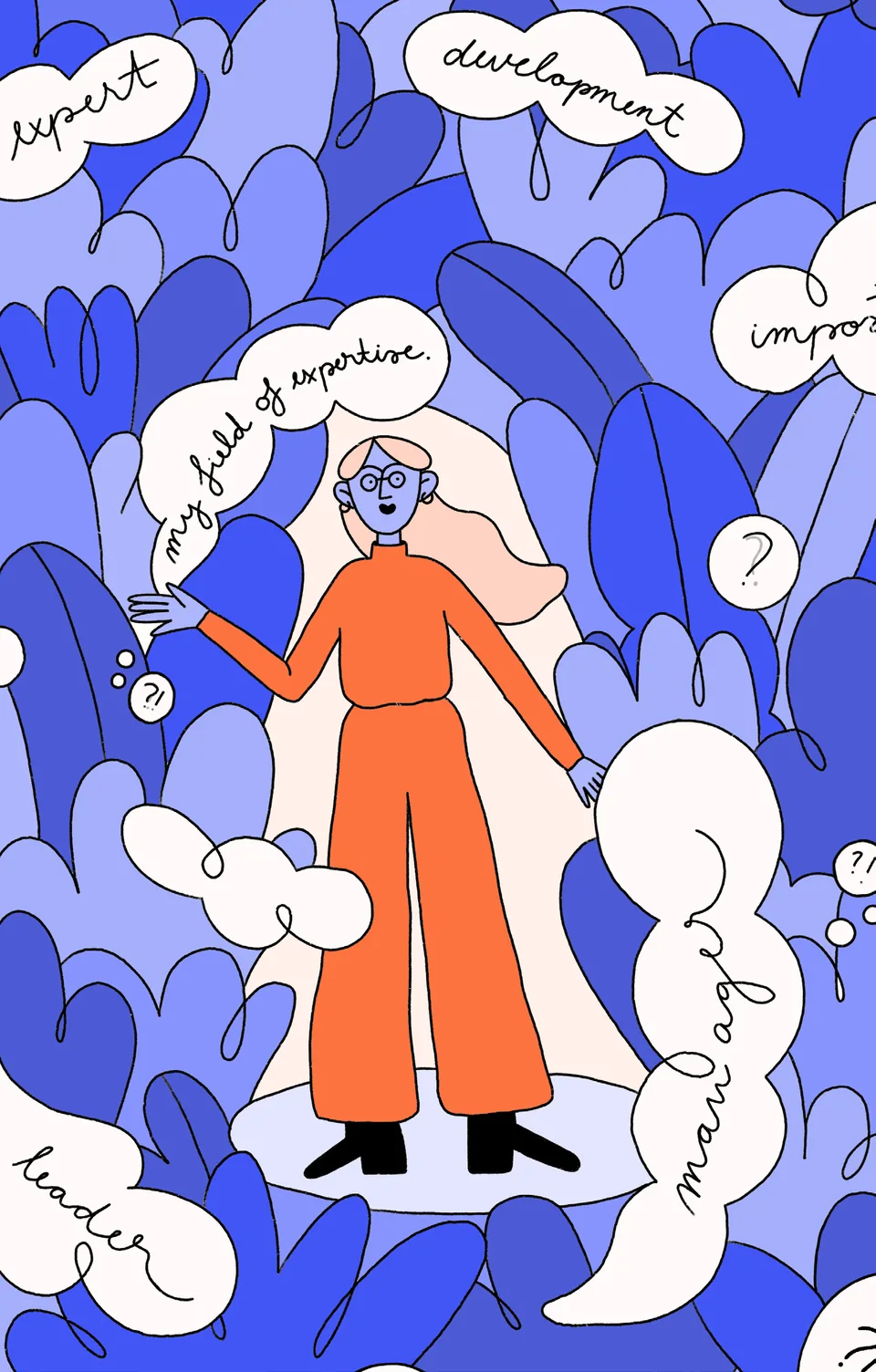
What will it be like when I’m on the stage talking about the development strategy we use at the company? Will I come across as authentic? Credible?
Oh no, the nervousness is setting in again. There was no stress in the days leading up to the stage appearance, but in the last few hours, it has found me once more. Even though I’ve done this several times... How many? Maybe 8 or 9. But this is the first in months.
My heart starts to pound so loudly I can hear it in the car. My hands are wet, and my breathing becomes too rapid—all the classic symptoms of stress.
“Okay, take it easy”, I tell myself. “I just need to focus on my breathing.”
Slow and long inhales, slow and long exhales. But it’s not helping. I’m almost there, yet I’ve forgotten how I’m supposed to start. What was my “funny introduction”? It doesn’t seem funny at all now. It was perfect on paper yesterday. But now, I feel the need for something new. However, I know I shouldn’t change the script just before going on.
A few hours later, as I’m coming down from the stage and the audience is still applauding, my fear transforms into something else. It’s still a kind of stress, but now it’s relieving. I try to recognize where I am. Until this moment, everything was as blurry as the morning, but now I’m beginning to notice the environment step by step. I hadn’t even been aware of the size of the stage or the number of people in the audience.
And during this moment of awakening and realization, while I’m becoming more present, a small queue forms in front of me, eager to ask questions. Most are inquiring about the specifics: “What exactly did you do?” This reminds me of my colleague in the coffee corner who criticized the time spent preparing for change. It feels as though everyone believes the preparation time, the time spent on understanding why, could have been bypassed. I recall a sentence from a teammate years ago when I was seeking an example. He said, “Sure, I can give you an example, but you know, people usually ask for examples because they think it will save time rather than understanding the theory.” But another thought brings me back to the present: It’s never the fault of the recipient if the message doesn’t get through.
So, we need to dispel the fog of uncertainty and delve into more details.
Strategies, Actions, and Tasks - The Blueprint for Execution, Page 126
Preparing for the Unexpected
“Do you know what a Near Miss is?” the lady asks. As the window for the online training isn’t even active, and I can’t find it with one click due to the many applications I’ve opened since the presentation started to lose my interest, it takes me several seconds to unmute myself to answer—counting from the moment I realized they were addressing me. Due to my attempt at multitasking, I’m unsure how long they waited, but at least I can respond. I proudly share the details of this quality term, proud because it’s a concept I’ve only known since yesterday. I learned about it due to a terrible home fire accident near me, which brought this safety and quality measure into a discussion with friends as we tried to figure out what happened. Fortunately, no one was hurt, but the damage was extensive. It was purely by luck that no one was at home. We could say it was a near miss. Ideally, a near miss would involve no fire at all.
The lessons from the mandatory online training don’t really stick in my head, a problem that’s becoming more frequent, especially with online sessions, as I try to master what I believe is multitasking. I imagine my mind has a certain bandwidth, and if the training or meeting isn’t engaging enough, the leftover bandwidth gets allocated to something else. This often results in the primary topic losing out in this capacity game, leaving me with nothing learned.
After the training ends and I realize I’m the last one in the online room, I ponder how to address this issue from the other side. If my interest wanes and my mind wanders during a meeting, it likely happens to others as well. How can I make things more interesting? How can I utilize the full bandwidth of attention? I’ve learned that our minds are inherently lazy, always looking to save energy, which is why we enjoy patterns, habits, and repetitive actions. Thus, I need to incorporate the unexpected and draw connections where none existed before, to keep things engaging.
Some days later, as I was preparing for the SWOT analysis with my team as the next step in our change process, I searched for an unexpected connection to “near miss” in software development, but without success.
However, during the workshop’s “threats” section, inspiration struck me. This was it. This was how I could facilitate understanding. Threats are those points that could cause significant issues if not managed.
After several coffee breaks and lunch breaks, we arrive at the meeting’s final part: the feedback round. “How did you like the workshop? What would you keep for next time? What would you drop or try?” These usual questions yield the usual answers. Perhaps this monotony is why my mind drifts yet again to the house fire and the affected family. Once more, I find myself multitasking, engaging in another task with half the efficiency that should be dedicated to the present.
How to prepare for the unexpected?
Mastering SWOT Analysis for Strategic Insight, Page 131
Midnight Clarity
Preparing for a meeting is usually easy for me, or it’s not even considered a task. It just happens. I try to be on time and read through the agenda if one exists. But today is different. As the person responsible for ensuring the meeting is perfect, effective, and creates value, I need to invest more time. How? When? I seemingly don’t have the time for this. “You have time for what you want”, echoes in my head. So, do I not want to? Why? Do I prefer to improvise? Is it not important? I can’t pinpoint the root cause of this negligence. Sitting in front of the slide deck to write and adapt it feels like physical pain.
Walking my dog during the nights, when the city reveals its calmer, colder, yet somehow friendlier face, usually soothes me. It’s the opposite of lying in bed, where all the small problems seem to grow overwhelmingly large and unmanageable. Out here, I’m merely an observer of my life, without acknowledging that I’m also the one who must address these challenges.
But now, with headphones on and rock ballads setting the backdrop to the rainy asphalt and sparkling lights on wet streets, I feel different. This little friend, Silva, is getting used to being led on the leash. I got her to fill the void and, honestly, she’s doing a fantastic job. She makes me smile with her almost-nothing gestures.
Morning came again, making it hard to get up on time because I had to stay up until dawn preparing all the slides. But it’s worth it. I’m responsible for leading this change, and I can’t afford to not wrap it up properly. This summary of our actions, a retrospective look at the last weeks and months—from the announcement through several workshops and customer visits—has convinced everyone that addressing individual needs and spending enough time understanding is not a waste. It’s been a journey from which I’ve learned a lot, and now my role is to highlight what we as a team have learned from it. I know it’s just a chapter, and the story goes on, but it was an important chapter in our lives, one that can only be properly evaluated with the support of time, from the future.
Let’s go, wrap up, and show them some light at the end of the tunnel.
See what kind of options we have to analyze our status:
Advanced Strategic Analysis: Beyond SWOT_Page 140